
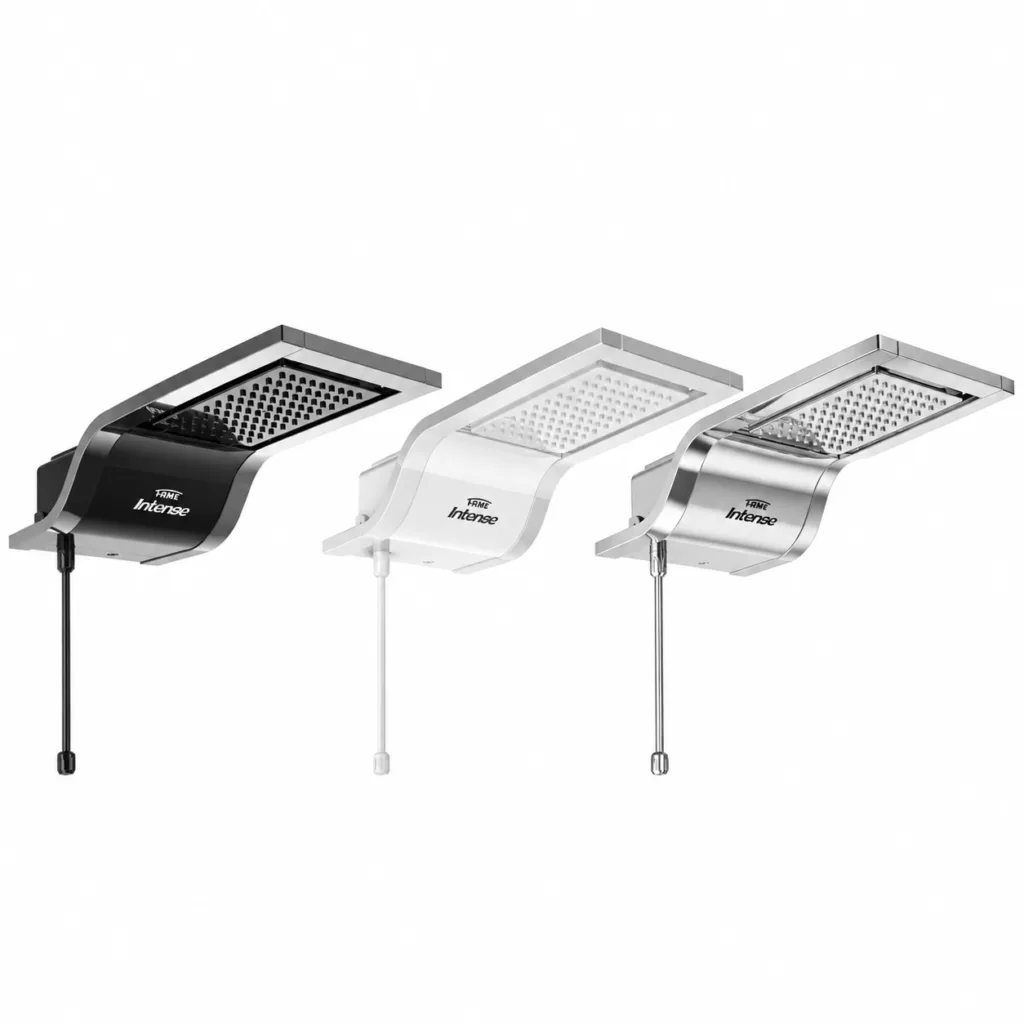
Can you shower without a geyser?
Short answer: yes, you can have hot showers without a geyser. An instant electric shower (an electric shower head that heats water itself) or an inline (tankless) water heater heats water the moment you need it — no hot-water tank, no waiting, and no geyser standing switched on all day. This guide explains how it works, the real benefits and drawbacks, what a shower costs to run, and how to choose the right one for your home.
A traditional geyser stores and reheats a large tank of water around the clock. An instant (on-demand) water heater does the opposite: it heats cold water as it flows, only while you’re actually using it. So instead of keeping 150 litres hot in case you need it, you heat just the water passing through the unit at that moment. For many South African homes — flats, cottages, granny flats, backrooms, outbuildings, or a home where the geyser has failed — that’s a simpler, more compact, and often cheaper way to get hot water.
How does hot water work without a geyser?
There’s a heating element inside the unit. When you open the tap or shower, water flows past the element and is heated instantly before it reaches you. The moment you close the tap, it stops heating. Because there’s no tank, there are no standing heat losses and no “running out” of hot water halfway through a shower — you get a continuous supply for as long as you need it.
How hot the water gets depends on three things: the shower’s power (most household electric showers are 5,400W to 6,500W), how cold the incoming water is, and how fast the water flows. Slower flow means hotter water — which is why electric showers have temperature settings and a pressure regulator.
Your options for geyser-free hot water
There are two main point-of-use options, plus the traditional geyser for comparison:
| Option | How it works | Best for |
|---|---|---|
| Instant electric shower | The shower head itself heats the water on demand. No geyser, no tank. | Bathrooms, flats, cottages, staff quarters, backup for a failed geyser. |
| Inline / tankless water heater | A compact unit heats water inline and feeds a shower or tap. | Point-of-use hot water at a basin, sink or shower where a geyser isn’t practical. |
| Instant hot water tap | The tap (faucet) itself heats the water as it flows. | A kitchen sink, basin or outside wash-up point. |
| Traditional geyser | Stores and continuously reheats a large tank of water. | Large households using a lot of hot water at multiple points at once. |
Who is a geyser-free shower ideal for?
- Flats and apartments without a dedicated geyser.
- Cottages, granny flats and backrooms where installing a full geyser is overkill.
- Outbuildings and staff accommodation that need hot water on their own.
- A broken geyser — an instant shower gets you hot water the same day, without a big replacement bill.
- Homes on a tank or low water pressure — many electric showers start working from very low pressure (see below), so they suit gravity-fed and JoJo-tank supplies.
- Rentals and new builds where a compact, lower-cost solution makes sense.
The benefits of going geyser-free
- Hot water in seconds, and it never runs out — no waiting for a tank to heat up, and the fifth person in the house gets the same hot shower as the first.
- You only pay while the water is running — a geyser is typically the single biggest electricity user in a South African home because it keeps reheating its tank all day and night. An instant shower uses no power at all between showers.
- Uses less water — an electric shower runs at a lower flow than a mains-pressure geyser shower (roughly 3–4 litres a minute for a hot shower on a 5,400W unit), and you don’t run the tap waiting for hot water to arrive.
- No burst-geyser risk — there’s no 150-litre tank in the roof to burst, leak into the ceiling or need an expensive replacement when it fails.
- Much cheaper to buy and install — an electric shower head costs a fraction of a new geyser, its valves, pipes and installation.
- Works on low water pressure — the FAME Super Ducha and Elegance showers operate from 13 kPa (about 1.3 m of water head) and the FAME Intense from 10 kPa, so a tank on a stand can be enough.
- Easy to maintain — on the FAME electric shower range, the heating element is user-replaceable: you can swap it yourself in minutes instead of paying for a call-out.
Electric shower pros and cons
An honest summary, so you can decide whether an electric shower suits your home:
| Pros | Cons |
|---|---|
| Instant, endless hot water | Lower flow than a mains-pressure geyser shower |
| No standing electricity use — power only while showering | Needs electricity while running, so no hot water during load-shedding without backup power |
| Cheap to buy and install compared to a geyser | Must be on its own circuit, installed by a qualified electrician |
| Nothing to burst or leak in the ceiling | In mid-winter, with very cold incoming water, you may need a lower flow to get a hot shower |
| Works on low water pressure and tank supplies | One unit serves one shower or tap — it isn’t a whole-house system |
| User-replaceable element (FAME range) | Draws a lot of power for a short time (about 23–25 A for a 5,400W unit), so check your supply |
Things to consider (so you buy the right one)
- It needs electricity to run. Because it heats on demand, it draws power while in use — so it won’t produce hot water during load-shedding unless you have backup power. A 5,400W shower is a heavy load for a small inverter, so check your backup system’s rating first.
- Have it installed by a qualified electrician on a dedicated circuit with the correct cable size, circuit breaker, earth-leakage protection and earthing, and get a Certificate of Compliance (CoC). This is important for safety — water and electricity must be installed correctly.
- Water pressure — check the unit’s pressure range against your supply. The FAME showers work from very low pressure up to 400 kPa; the FAME inline water heater needs 20–200 kPa, so very high mains pressure may need a pressure-reducing valve.
- Power and climate — a higher-wattage shower gives hotter water at a stronger flow, which helps in colder areas and in winter.
- Household size — for a single bathroom or point of use, an instant unit is perfect; very large homes running multiple hot taps at once may still prefer a geyser.
Electric shower vs geyser: the cost picture
There are two costs to weigh — upfront and running. On upfront cost, an instant electric shower or inline water heater is a fraction of the price of buying and installing a geyser. On running cost, a geyser consumes electricity continuously to keep its tank hot (even when you’re at work or asleep), while an instant shower only draws power during the minutes you’re actually showering. For a smaller household, or a second bathroom/outbuilding, that usually adds up to real savings — and you avoid the big replacement bill when a geyser eventually fails.
What does an electric shower cost per shower?
Electricity use is simple to work out: power × time. A 5,400W (5.4 kW) shower running for 10 minutes uses 5.4 × 10/60 = 0.9 kWh. At an example tariff of R3.50 per kWh, that’s about R3.15 per 10-minute shower.
| Setting | Power | 10-minute shower | Cost at R3.50/kWh |
|---|---|---|---|
| FAME Intense, economy setting | about 2,525W | 0.42 kWh | about R1.47 |
| FAME Super Ducha, Hot setting | 3,200W | 0.53 kWh | about R1.87 |
| 5,400W shower, full power | 5,400W | 0.90 kWh | about R3.15 |
| FAME Intense, full power | 6,500W | 1.08 kWh | about R3.79 |
Your own cost depends on your municipal or Eskom tariff and how long you shower — multiply the kWh above by your rate per kWh. A shorter shower or a lower setting in summer brings it down further. With a geyser, you pay to heat a whole tank of water plus the heat it loses standing in the roof, whether or not anyone showers.
Which FAME electric shower should I choose?
Securadeal stocks the full FAME instant hot water range. Here’s how the models compare:
| Model | Power | Controls | Finishes | Best for |
|---|---|---|---|---|
| FAME Super Ducha shower | 5,400W | 4 settings: Cold, Warm, Hot, Super Hot | Black, White | Best value everyday shower |
| FAME Elegance shower | 5,400W | 4 settings: Cold, Warm, Hot, Super Hot; water economiser included | — | A sleek shower at a mid-range price |
| FAME Intense shower | 6,500W | Electronic temperature control, economy setting, pressure regulation | Black, White, Chrome | The most control and the hottest water, for colder areas |
| FAME Compacta shower | Up to 7,800W, depending on version | See product page | Black, White, Chrome | Three finishes at a mid-range price |
| FAME Inline water heater | 5,400W | Heats water inline, feeds a shower or tap | — | When you want to keep your own shower head or tap |
| FAME Elegance hot water tap | — | 4 settings: Off, Warm, Hot, Super Hot | Black, White | Hot water at a kitchen sink or basin |
Replacement elements: keep a spare so a burnt-out element never leaves you without hot water — the Intense element (also fits the Compacta), Compacta element (also fits the Intense), Super Ducha element and inline water heater element.
How to choose
Match the unit to where you need hot water:
- Need a hot shower without a geyser? Choose an instant electric shower — the FAME Super Ducha is the best-value option, and the FAME Intense gives the most power and control.
- Need hot water fed to a shower or tap from a compact point-of-use unit? Look at an instant inline water heater such as the FAME Instant Inline Electric Water Heater.
- Want hot water right at the basin or sink? The FAME Elegance Instant Electric Hot Water Tap gives you hot water at the tap with no geyser.
Frequently asked questions
Do I need a geyser for an electric shower?
No. An electric shower heats water instantly as it flows, so no geyser or hot-water tank is required — you get continuous hot water on demand.
What are the benefits of an electric shower?
Instant hot water that never runs out, no electricity used between showers, lower water use, nothing to burst in the ceiling, low purchase and installation cost, and it works on low water pressure. On the FAME range you can also replace the element yourself.
Is an inline water heater the same as a geyser?
An inline water heater — also called an inline geyser or tankless heater — heats water instantly as it flows. It’s a compact, point-of-use alternative to a bulky geyser tank.
Does an electric shower use less electricity than a geyser?
It only heats water while you shower, instead of keeping a full tank hot all day, which can significantly cut your water-heating costs. A 10-minute shower on a 5,400W unit uses about 0.9 kWh.
How much does an electric shower cost to run?
Multiply the power by the time: a 5,400W shower for 10 minutes uses about 0.9 kWh, which is roughly R3 at R3.50 per kWh. Lower settings use less — the FAME Intense economy setting (about 2,525W) uses under half that.
Do I need an electrician to install an electric shower?
Yes. It must be on its own circuit with the correct cable, circuit breaker, earth-leakage protection and earthing, installed by a qualified electrician who can issue a Certificate of Compliance. The plumbing side is simple: it connects to the cold-water shower arm.
Are electric showers safe?
Yes, when installed correctly. Water and electricity are kept separate inside the unit, and the FAME Super Ducha and Elegance are rated for use with earth-leakage protection (RCCB/GFCI). Never install one yourself without an electrician, and switch off the breaker before replacing the element.
Will an electric shower work with low water pressure?
Usually, yes. The FAME Super Ducha and Elegance operate from 13 kPa (about 1.3 m of water head) and the FAME Intense from 10 kPa, so they suit gravity-fed and tank supplies.
Can I replace the heating element myself?
On the FAME range, yes — the element is user-replaceable. Switch off the power, unscrew the old element and fit a new one in minutes, saving on call-outs and extending the unit’s life.
Will it work during load-shedding?
Only if you have backup power that can handle the load — a 5,400W shower needs a large inverter. Because an instant shower heats on demand, it needs electricity while in use. It does, however, save the standing electricity a geyser uses to stay hot the rest of the day.
Ready to go geyser-free?
Browse our range of instant electric showers and inline water heaters — compact, affordable, easy to maintain, and built to give you hot water without a geyser. Not sure which is right for your home? Contact the Securadeal team and we’ll help you choose.